 BUND FINANCE
 › Glossary
Learn
Stock market glossary
50 terms explained in plain language. Type to filter.
Nothing matches that word.
- Analyst consensus(Consenso de analistas)
The average of what analysts expect for a quarter’s revenue or earnings.
- ATR
Average True Range: how much the price moves on an average day. Used to measure volatility and place stops.
- Beta
How much a stock moves versus the market. Beta 1.5 = it tends to move 50% more than the S&P 500.
- Bollinger Bands(Bandas de Bollinger)
A moving average with two bands 2 standard deviations away. They widen when volatility rises and narrow when it falls.
- Bond(Bono)
A loan you make to a government or company in exchange for interest and repayment at maturity.
- Call
An option giving the right (not the obligation) to buy 100 shares at a fixed price (strike) until expiration.
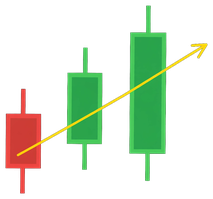
- Candlestick(Vela japonesa)
Shows a period’s open, high, low and close. Green if it closed above the open; red if below.
- Cash-secured put
Selling a put while holding the cash to buy the shares if assigned. You collect the premium in exchange.
- Compound interest(Interés compuesto)
Earning interest on interest already earned. Over time, it makes savings grow faster.
- Covered call
Selling a call on 100 shares you own. You collect the premium but cap the upside above the strike.
- Delta
How much an option’s price changes if the stock rises US$1. Also read as the rough probability of finishing in the money.
- Diversification(Diversificación)
Spreading money across different assets so a single mistake weighs less.
- Dividend(Dividendo)
Part of a company’s profits paid to shareholders, usually each quarter.
- Drawdown(Drawdown (caída máxima))
The largest fall from a peak to a trough in a period. It measures how much pain an investment endured.
- Earnings(Earnings (resultados))
A company’s quarterly report: revenue, profit and what management expects.
- ETF
A fund that trades like a stock and holds many assets (for example, the 500 companies of the S&P 500).
- Expiration(Vencimiento)
The date an option stops existing.
- Free cash flow(Flujo de caja libre)
Cash the business generates after investing in its assets (capex).
- Gamma
How much an option’s delta changes when the stock moves US$1.
- Guidance
What management says it expects for the next quarter or year (revenue, margins, earnings).
- Implied volatility(Volatilidad implícita)
The future volatility the market is “pricing in” to options.
- Index(Índice)
A basket that summarizes a market, such as the S&P 500, Nasdaq 100 or Dow Jones.
- Leverage(Apalancamiento)
Using borrowed money (or derivatives) to control a position larger than your capital. It magnifies gains and losses.
- Limit order(Orden límite)
An order that only executes at your price or better.
- Liquidity(Liquidez)
How easily an asset can be bought or sold without moving its price much.
- MACD
An indicator comparing two exponential moving averages (12 and 26) to show momentum and trend changes.
- Market capitalization(Capitalización de mercado)
Share price times shares outstanding: what the market says the company is worth.
- Market order(Orden de mercado)
An order that executes immediately at the best available price.
- Moving average (SMA / EMA)(Media móvil (SMA / EMA))
The average price of the last N days. The SMA weighs each day equally; the EMA gives more weight to recent days.
- Operating margin(Margen operativo)
Of every US$100 sold, what the company earns from operations before interest and taxes.
- Option(Opción)
A contract giving the right to buy (call) or sell (put) 100 shares at a fixed price until a date.
- P/E ratio(PER (P/E))
Share price divided by earnings per share: how many years of current earnings the market pays.
- Pip
The smallest price change in a currency pair (usually 0.0001).
- Pre-market and after-hours(Pre-market y post-market)
The sessions before the open (4:00–9:30 a.m.) and after the close (4:00–8:00 p.m.) in New York.
- Put
An option giving the right (not the obligation) to sell 100 shares at a fixed price until expiration.
- Resistance(Resistencia)
A price zone where sellers showed up before and the price stalled.
- Rho
How much an option’s price changes if interest rates rise one point.
- RSI
Relative Strength Index (0 to 100). Above 70 is often read as overbought and below 30 as oversold; they are not signals on their own.
- Short selling(Venta en corto)
Selling borrowed shares hoping to buy them back cheaper. The possible loss is unlimited.
- Spread
The difference between the buy (ask) and sell (bid) price.
- Stock(Acción)
A share of ownership in a company. If the company grows, the stock can be worth more; if it does badly, less.
- Stop loss
An order to exit a position if the price reaches a level, to limit the loss.
- Strike
The fixed price at which an option lets you buy or sell the stock.
- Support(Soporte)
A price zone where buyers showed up before and the price stopped falling.
- Theta
How much value an option loses each day that passes, all else equal.
- Vega
How much an option’s price changes if implied volatility rises one point.
- Volatility(Volatilidad)
How much a price moves up and down. More volatility = bigger moves in both directions.
- Volume(Volumen)
How many shares traded in a period. Moves on heavy volume usually carry more weight.
Continue with the learning path → · Options glossary A–Z in the Options Tutorial →
Not financial advice. BUND FINANCE is an educational platform: it does not recommend buying or selling any asset. Investing involves risk of loss.